About me I've been a computer programmer since I first started typing in program listings on a Commodore Vic 20 when I was about 8. My hobbies include electronics, CNC manufacturing, photography, beer and winemaking.
I live with my wife and lots of left-over parts from unfinished projects in Lincoln, Nebraska, USA.]
Blog
14 January 2013, 13:42 UTCHash saturation calculator
In the quest to "prove" the quality of the numbers output by my Arduino Random Number Generator, I've come across
the concept of hash
saturation while reading about the turbid random number generator which uses
noise plus hash to give high quality random numbers. Implicitly I've
relied on hash saturation all along, but now I have is a mathematical
basis for this reliance.7 March 2012, 15:42 UTCCancellation error
I was recently reminded of the importance of choosing numeric algorithms that
don't behave catastrophically for certain inputs. One example is the
calculation of 1-cos(θ) for small θ. In this case, cos(θ) is very close to 1,
leading to a large
cancellation error in the subtraction step.
Hash saturation calculator
In the quest to "prove" the quality of the numbers output by my Arduino Random Number Generator, I've come across the concept of hash saturation while reading about the turbid random number generator which uses noise plus hash to give high quality random numbers. Implicitly I've relied on hash saturation all along, but now I have is a mathematical basis for this reliance.
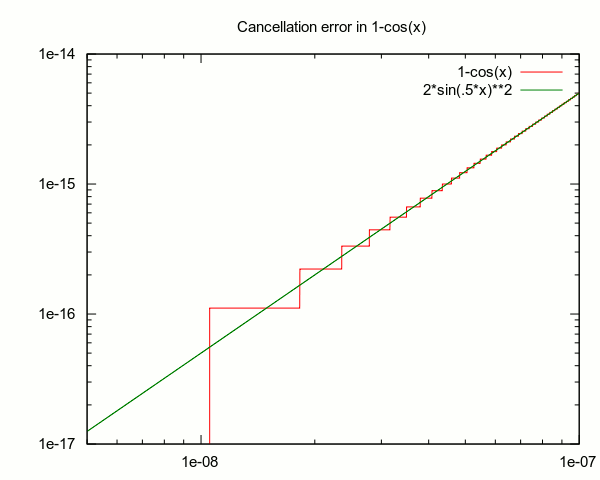
Cancellation error
I was recently reminded of the importance of choosing numeric algorithms that don't behave catastrophically for certain inputs. One example is the calculation of 1-cos(θ) for small θ. In this case, cos(θ) is very close to 1, leading to a large cancellation error in the subtraction step.
All older entries
Website Copyright © 2004-2024 Jeff Epler